

Key takeaways
- Per 500 ml, coconut water has roughly 825–1,250 mg potassium but only 130–525 mg sodium.
- Sweat is mostly sodium, so coconut water is a weaker match for heavy sweat losses.
- Two trials found coconut water rehydrates about as well as a sports drink after moderate exercise.
- It's a good everyday drink, but people with kidney disease or high potassium should avoid it (ICMR).
Tender coconut water is India's original sports drink. It's sold at every corner, it's natural, and ICMR's dietary guidelines call it "a good hydrating beverage".2 So is it as good as an electrolyte drink? For some jobs, yes. For replacing heavy sweat, not quite, and the reason is one mineral.
What's in coconut water?
Coconut water's composition varies a lot with the variety, the age of the nut and the season. The two USDA entries give a sense of the range per 100 g:1
- Sodium: 26–105 mg
- Potassium: 165–250 mg
- Sugars: 2.6–3.9 g
- Energy: 18–19 kcal (ICMR lists 15 kcal per 100 ml)2
So a 500 ml serving, roughly one large tender coconut, carries a lot of potassium, a modest and variable amount of sodium, and 13–20 g of natural sugar.
Coconut water vs an electrolyte drink, per 500 ml
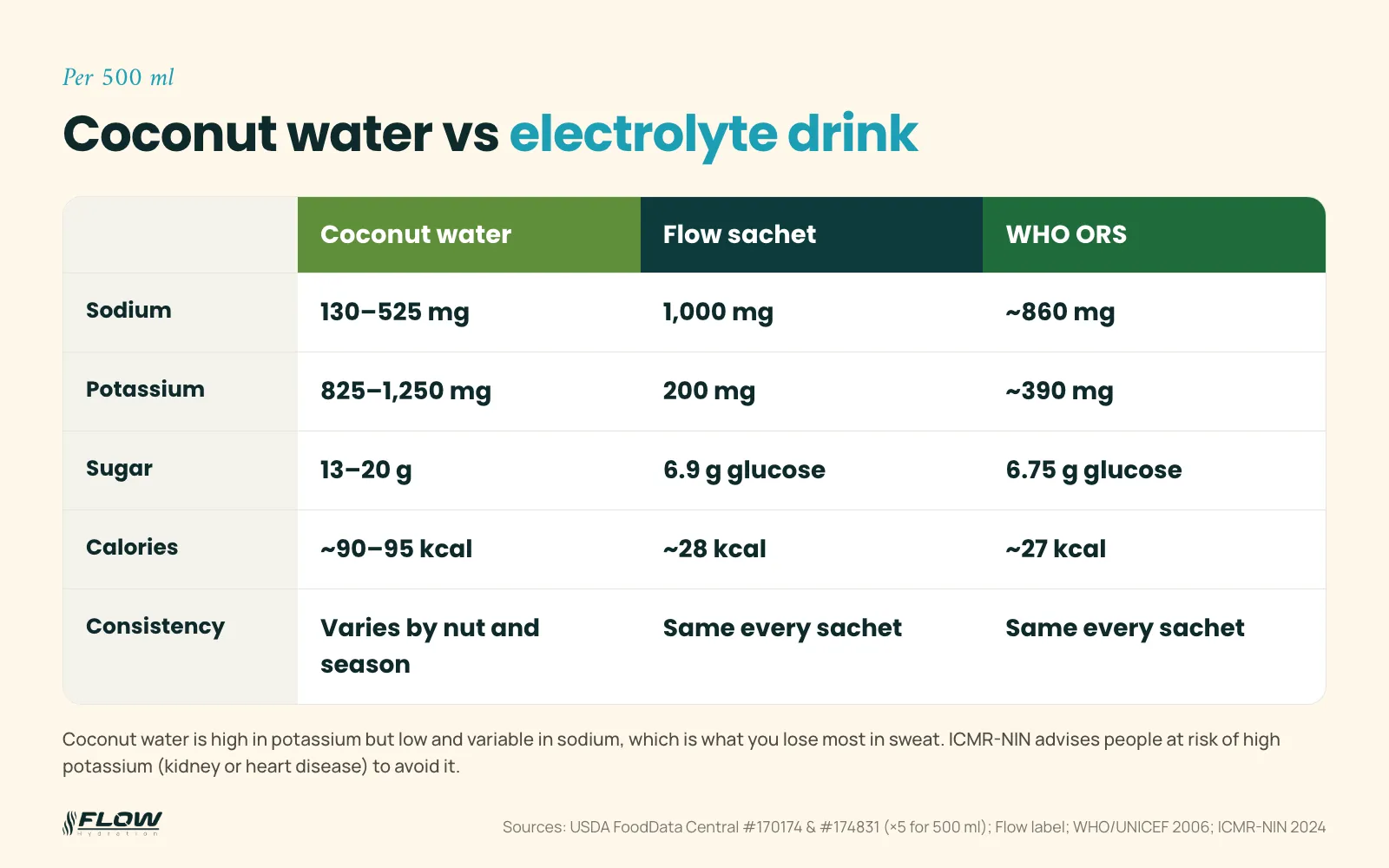
The key difference is sodium versus potassium. Sweat is mostly sodium chloride. Athletes lose about 825 mg of sodium per litre of sweat on average, and much less potassium.5 Coconut water is the reverse: high in potassium, low in sodium. WHO-formula ORS and most sports electrolyte drinks are built around sodium.6
What the studies show
Two controlled trials have compared coconut water with sports drinks for rehydration after exercise:
- In a Malaysian study, men exercised in the heat until they lost about 2.8% of body weight, then drank 120% of that loss as fresh young coconut water, a sports drink or plain water. All three rehydrated similarly. Coconut water was sweeter and caused less nausea and fullness than the sports drink.4
- In a US study, trained men lost about 2% of body weight on a treadmill, then drank coconut water, coconut water from concentrate, a sports drink or bottled water. Rehydration and later exercise performance were similar across all four, but coconut water caused more bloating and stomach upset.3
So for moderate, one-off dehydration, coconut water works about as well as a sports drink. The studies didn't test long, very sweaty efforts, where sodium losses add up hour after hour.
When coconut water is a great choice
- Everyday hydration on a hot day, instead of soft drinks or packaged juice, as ICMR recommends2
- After a short or moderate workout
- When you want potassium: ICMR's guidance includes tender coconut water among "excellent alternatives to synthetic drinks"2
- Recovering from a mild stomach upset, if you're keeping food down (for diarrhoea, ORS is still the standard)
When an electrolyte drink is better
- Long runs, rides, matches and treks, and heavy, salty sweaters
- When you need a consistent, known dose. One nut can have four times the sodium of another.1
- When you need to retain fluid. Sodium is what helps the body keep water rather than pass it.7
- On the move, where carrying coconuts isn't practical
Who should be careful with coconut water
Because it's so high in potassium, ICMR advises that people prone to high blood potassium, such as those with kidney disease or some heart conditions, should avoid tender coconut water.2 Check with your doctor if you take medicines that raise potassium, such as some blood-pressure drugs.
The best of both
You don't have to choose. On a long hot day, many runners drink coconut water afterwards for potassium and taste, and use a sodium-led electrolyte drink like Flow during the effort itself. You can also add a pinch of salt to coconut water to raise its sodium. See our homemade electrolyte drink for the maths.
Frequently asked questions
Is coconut water an electrolyte drink?
Is coconut water better than ORS?
Can I drink coconut water after a workout?
Who should not drink coconut water?
References
- 1.U.S. Department of Agriculture, FoodData Central. Nuts, coconut water (liquid from coconuts), FDC ID 170174; Beverages, coconut water, ready-to-drink, unsweetened, FDC ID 174831. fdc.nal.usda.gov/
- 2.ICMR–National Institute of Nutrition. Dietary Guidelines for Indians, 2024 (Guideline 11: Restrict salt intake; Guideline 14: Drink adequate quantity of water). www.nin.res.in/dietaryguidelines/
- 3.Kalman DS, Feldman S, Krieger DR, Bloomer RJ. Comparison of coconut water and a carbohydrate-electrolyte sport drink on measures of hydration and physical performance in exercise-trained men. J Int Soc Sports Nutr. 2012;9(1):1. doi.org/10.1186/1550-2783-9-1
- 4.Saat M, Singh R, Sirisinghe RG, Nawawi M. Rehydration after exercise with fresh young coconut water, carbohydrate-electrolyte beverage and plain water. J Physiol Anthropol Appl Human Sci. 2002;21(2):93–104. doi.org/10.2114/jpa.21.93
- 5.Baker LB, Barnes KA, Anderson ML, Passe DH, Stofan JR. Normative data for regional sweat sodium concentration and whole-body sweating rate in athletes. J Sports Sci. 2016;34(4):358–368. doi.org/10.1080/02640414.2015.1055291
- 6.World Health Organization & UNICEF. Oral rehydration salts: production of the new ORS. WHO/FCH/CAH/06.1. Geneva: WHO; 2006. www.who.int/publications/i/item/WHO-FCH-CAH-06.1
- 7.Maughan RJ, Watson P, Cordery PA, et al. A randomized trial to assess the potential of different beverages to affect hydration status: development of a beverage hydration index. Am J Clin Nutr. 2016;103(3):717–723. doi.org/10.3945/ajcn.115.114769
Kavya · Flow Hydration team
Writes about everyday hydration: water, coconut water, nimbu pani and what Indian dietary guidelines actually recommend.
First published 7 May 2026. This article is general information, not medical advice. If you have a medical condition, talk to your doctor.
Keep reading
12 October 2026 · 9 min read
Electrolyte Powder: Benefits, Uses and Who Actually Needs It
What each electrolyte does, the benefits the research supports, who needs a sachet and who doesn't, and how to read a label in India.
Read more
12 October 2026 · 7 min read
Sugar-Free Electrolyte Powder: Do Electrolyte Drinks Need Sugar?
A little glucose helps absorb sodium and water; a lot is a soft drink. How to choose between sugar-free and low-sugar electrolytes.
Read more
12 October 2026 · 8 min read
ORS vs Electrolyte Drinks: What's the Difference (and What FSSAI Changed)
ORS isn't banned, but sugary drinks can no longer use its name. The WHO formula, what FSSAI changed, and when to choose ORS over an electrolyte drink.
Read more